PROJECTS
ARCHANGELOS MICHAEL CHURCH
Start Date: October 2019
End Date: October 2020
Type of Intervention: Conservation works
Total Project Cost: 320,000 USD
ABOUT THE CHURCH
The church of Archangelos Michael, located in the Karpasia/Karpaz area, constitutes the principal church of the area.
The church is the result of several construction phases dating from the Byzantine period to the middle of the 20th century. It is a twin church; a composition of two churches attached to each other with an additional open portico to the south side. The older part of the church on the northern side consists of two basic parts, the main church and the narthex to the west. While scholars have proposed slightly different dates for its construction, it has been generally dated to the Byzantine period. The church is of the cross-in-square type with four piers on which a cylindrical dome is resting. The central and side aisles are roofed by cylindrical vaults. To the east, there is a projecting semicircular apse. Interesting features of the apse are the triple-light window and the double sawtooth brick cornice which are common characteristics of Byzantine architecture but are relatively scarce in Cyprus. The north facade is formed by three large blind arches which is also a typical characteristic of Byzantine architecture.
One of the original entrances to the church, which was located in the middle of the north wall, was blocked and replaced by a new entrance further to the west in the late 19th century.
Internally, remnants of at least two different periods of wall paintings are visible. On the south wall, there is a large wall painting of Archangelos Michael and small remnants of other paintings are visible on many locations within the church. Above the north entrance there was part of another wall painting of Archangelos Michael which due to water penetration collapsed recently. Remains of the collapsed painting were collected during the works, are safely kept and will be restored as soon as possible.
The church was extended to the west in the late Byzantine period, and a narthex was created. The narthex is of the cross-in-square compressed type and is also covered by a cylindrical dome in the center and cylindrical vaults to the north and south sides. The dome of the narthex does not have any windows. On the external side of the north wall there is a series of five recessed flat blind arches over a horizontal string-course. The external flat blind arch is a characteristic feature of Byzantine architecture which is met only in few churches in Cyprus.
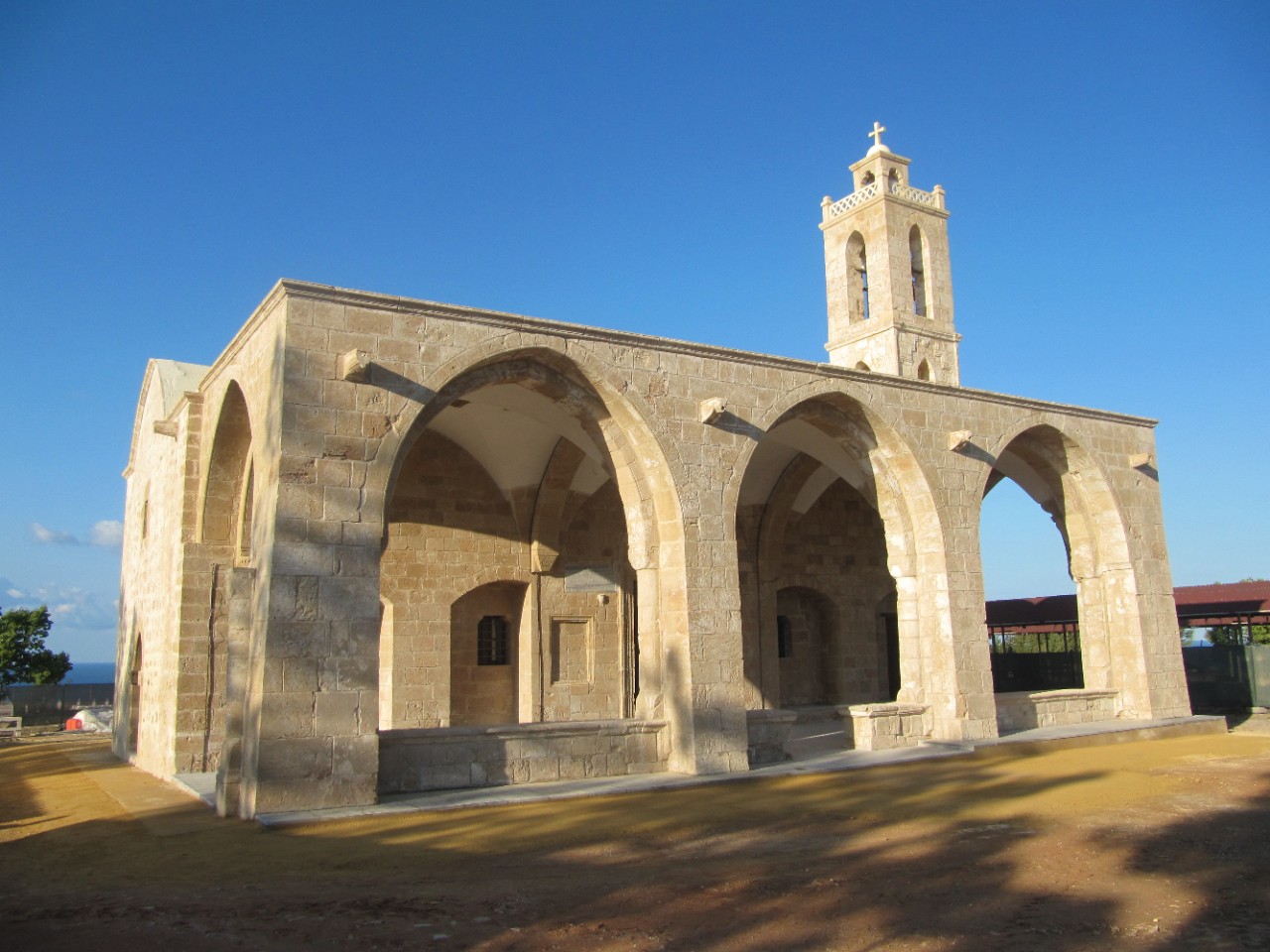
It is hypothesized that the new church was constructed on the south side of the byzantine church in 1794; the two churches were connected as one complex. Three arched openings were arranged along the south wall of the byzantine church to facilitate communication between the two churches. The new church is of the single-nave type covered by a pointed vault, which is a typical feature of this period. It is wider, longer and higher than the first one and has a five-sided apse to the east.
To the west there is a women’s gallery, also known as “gynaikonites,” on the second level, access to which is provided by narrow and steep stone and wooden stairs.
On the southeast corner of the 18th century church, a belfry was erected towards the end of 19th century. To the south side of the complex an open portico was added in the late 19th or early 20th century.
Other, more recent, architectural interventions include a new doorway on the south side of the church (1944) which was modified and became the main entrance, reformation of the 18th century apse window, possibly of the same period and the construction of a new mosaic floor in the 18th century church above the original marble one.
THE CONSERVATION PROJECT
- Removal of incompatible renders, cleaning of the masonry, and replastering where needed;
- Revealing and conserving historical plasters and wall paintings by a conservator; – Conserving of original doors and windows;
- Structural consolidation of the church fabric, including:
- Replacing and dismantling of stones and rebuilding where needed;
- Grouting;
- Restoring the original system of timber beams;
- Replacing inappropriate cement interventions.
- Conserving the byzantine church floor;
- Removing the 20th century floor from the 18th century church and revealing the historical floor;
- Installing new floor at the south arcade;
- Conserving the women’s gallery;
- Cleaning, treating the cracks and applying waterproofing on the roof;
- Treating metal items;
- Conserving timber iconostasis and timber ambon by a conservator;
- Minimal electrical installation.
This project is financed under the scheme of the TCCH self-funded projects and implemented by UNDP in partnership with the Technical Committee on Cultural Heritage. Since 2012 approximately €27 million has been invested by several donors, benefiting over 100 Cultural Heritage Sites across Cyprus to implement the priorities of the Technical Committee on Cultural Heritage for the preservation of the island-wide cultural heritage in Cyprus.